

On Shape, Structure, and How Tattoos Change the Body
Updated: Mar 14
Recently, my attention has been on large-scale tattoos and their potential to change how we perceive the body—it’s shape, size, and presence.
A large scale tattoo can shift how the body is read as a whole.
Think about this: when you look at someone’s back, you naturally use their shoulders and hips as reference points to judge the height of their torso. But when you introduce a large, intentional tattoo, those reference points can change. If the design flows below the hip bones then the base of the design becomes the new lower reference point, making the torso appear longer.
Shapes that are broader at the shoulders and narrower at the waist can create an hourglass effect. Using the contrast of lighter and darker shades can pull attention away from unflattering areas. Rounded shapes that contour the scapula can increase the effect of the shoulder blades being pulled down and together (a key visual marker of posture).
Straight, angular lines tend to feel solid and strong. Blocky shapes give a sense of weight and stability. Curved, wavy shapes feel more fluid. Rounded shapes often read as more approachable, while sharp or triangular shapes feel edgier. Shape carries meaning, whether we’re consciously aware of it or not.
What I’m most interested in is reworking the overall shape and feeling of the back, and how that connects to posture and presence. We instinctively notice how people carry themselves. Adding art that reinforces expansion, strength, or balance can change the overall impression of a person, and often how they feel in their own body, too.
This is something I’ve experienced firsthand. When I was younger, I had a very poor posture, something I’ve worked hard to correct over time. One of my goals with my own back tattoo was to solidify that work, with a design that was expansive across the shoulders, visually reinforcing width and lift.
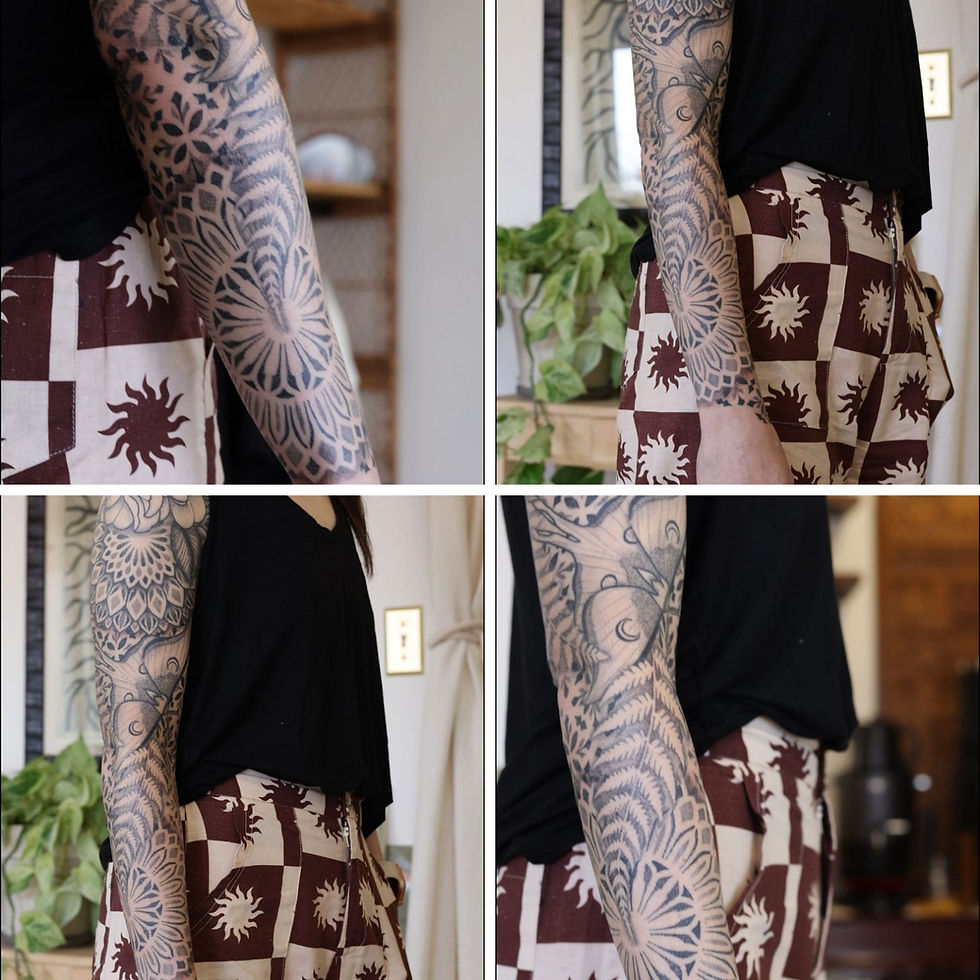
These same principles apply to other areas of the body. With arm sleeves, for example, it’s important to treat the arm as one continuous canvas. When elements connect through the elbow instead of stopping and starting, the arm reads as longer and more cohesive. On legs, placing a focal point—like a circular element —slightly above the knee’s center can change how the leg’s angles are perceived, making it feel stronger and more stable.
This is also why I often encourage clients who are interested in large-scale work to think about the full piece early on. When a sleeve is split into an upper and lower section, you lose the ability to create a single structure that flows from top to bottom. It will almost always read as two separate parts rather than one unified design.
If cost is a concern, my advice is to wait and save until you can commission a full piece as one cohesive design. The sooner you know the eventual size and scope of the tattoo you want, the better it will be in the long run.
Below, you can see a few photos of a sleeve I recently completed for my client Jen. I think this is a great example of the flow I’m talking about. There's a continuous line of energy. That line is carried from top to bottom with one fern on the inner arm, leading into the moth, and then a second fern along the outer arm. Together, they form an S-curve that follows the musculature of the bicep into that of the outer forearm.
The mandalas counterbalance that movement—one placed to the left of the upper fern, the other to the right of the lower fern—so the sleeve has a sense of twist without feeling overly dynamic. The circular shapes stabilize the composition.
There’s also a continuous pattern that runs from the wrist up into the armpit, which helps create cohesion between the lower and upper arm and makes the sleeve read as one connected piece.
Changing the overall look and feel of a person’s body is something I take seriously. It’s important to be intentional about it, and I’ll always take the time to sit with you and explain my design choices, with an open ear for your thoughts and interests.
Tattooing isn’t just about placing images—it’s about how those images interact with the body and change how it’s seen.
If you’re considering a large scale piece and want to think through the structure of it together, I’m always happy to start that conversation. You can reach out through my booking page, or join my newsletter to receive future essays like this one as they're released.
—Kyle


Comments